 Music therapy · Stress regulation
Stress is part of life. It helps us respond to demands, make decisions and remain capable of acting in challenging situations. It becomes particularly difficult when tension continues for a long time and adequate periods of recovery are missing. This is where music therapy for stress regulation may be helpful: not as a quick fix or a promise of healing, but as a professionally guided way to notice bodily signals, regulate activation and regain access to recovery.
What happens in the body during stress?
When the brain interprets a situation as demanding or threatening, the body prepares for action. Attention, muscle tension, breathing and cardiovascular activity may change. The sympathetic branch of the autonomic nervous system supports the mobilisation of energy, while the parasympathetic branch is more closely involved in rest, digestion and recovery.
Both systems are necessary. Good stress regulation is therefore not about eliminating activation, but about being able to move flexibly between activation and recovery. When the body remains in a state of heightened readiness, people may experience restlessness, sleep problems, irritability or difficulty concentrating. The World Health Organization notes that prolonged stress can affect both physical and mental wellbeing and may worsen existing health problems.
How can sound and rhythm support regulation?
Music engages several processes at the same time: perception, attention, emotion, memory, movement and social interaction. It is not only processed cognitively; it is often experienced physically as well. However, music does not affect everyone in the same way. Personal history, cultural background, current mood, volume, tempo and individual preference all influence the response.
1. Rhythm provides temporal orientation
A steady pulse can structure movement and breathing. Repetition creates predictability and may therefore provide orientation. Slow musical patterns may encourage calmer breathing, while fast, loud or strongly accented music may increase activation. Research on tempo and physiological responses highlights an important point: music is not automatically relaxing. Its effect depends on how it is designed and used.
2. Sound guides attention
During periods of stress, thoughts often circle around tasks, conflicts or possible risks. Intentional listening can provide a concrete anchor for attention: a tone, timbre, melody or pause. This does not remove the source of stress, but it may make it easier to step briefly out of repetitive thinking and notice bodily sensations more clearly.
3. Making music can strengthen self-efficacy
Active music therapy may involve simple instruments, the voice, movement or improvisation. Musical performance is not the goal. A person can shape volume, tempo, duration and intensity and directly perceive the result. This experience – “I can change something and notice its effect” – may support self-efficacy and regulation.
4. Shared music-making enables co-regulation
People do not regulate only by themselves. A reliable voice, eye contact, tempo and response from another person can provide safety and orientation. In a music therapy group, this coordination may develop through a shared pulse, musical dialogue or clearly structured transitions between activity and rest. For teams, these experiences may also strengthen awareness of others and a sense of social connection.
Listening to music and music therapy are not the same
A personally selected playlist can be useful in everyday life. Music therapy, however, goes further. The German Music Therapy Society describes music therapy as the purposeful use of music within a therapeutic relationship to maintain and promote mental, physical and cognitive health.
Qualified music therapy takes into account factors such as:
- the person’s current level of activation and individual goal,
- personal responses to sound, rhythm, voice and silence,
- biographical and cultural meanings of music,
- physical and psychological limits,
- the appropriate balance between activation and calming,
- how useful experiences can be transferred into daily life.
Depending on the goal, receptive methods – such as intentional listening, sound awareness or music-assisted relaxation – may be combined with active methods such as improvisation, drumming, singing or movement. No instrumental skills or previous musical experience are required.
What does the research say?
Scientific research offers encouraging, but not uniform, findings. A large systematic review with two meta-analyses examined 104 randomised studies involving 9,617 participants. On average, music-based interventions showed favourable effects on psychological and physiological stress-related outcomes. A further meta-analysis focusing specifically on music therapy included 47 studies with 2,747 participants and also found positive average effects on stress-related outcomes.
At the same time, the studies differed considerably in their populations, methods, duration and outcome measures. Some laboratory studies, for example, did not find a clear reduction in cortisol after music listening. Heart rate, breathing and perceived stress do not change in the same way for every person either.
The appropriate conclusion is therefore that music therapy may support stress regulation. Its effects depend on the person, the context, the musical process, the therapeutic relationship and regularity. It does not replace medical assessment or necessary psychological or psychiatric treatment.
What might a stress-regulation session look like?
A session will often not begin immediately with “relaxing music”. It may start with a brief assessment of the person’s present state: How high is the current level of activation? Where is tension noticeable? Is calming needed, or would movement be more helpful first?
An individually adapted musical process may then include:
- arriving and orienting to the body,
- rhythmic or movement-based activity to release excess tension,
- a transition towards quieter sounds or intentional listening,
- a brief period of silence and noticing,
- reflection and transfer into everyday life.
Some people access recovery directly through quiet sounds. Others first need an active phase in which restlessness can be expressed through music. Professional support means respecting these differences instead of offering the same music or exercise to everyone.
A brief exercise for everyday life
The following exercise is not music therapy, but it may support mindful self-observation:
- Rate your current tension on a scale from 0 to 10.
- Choose a familiar piece of music that feels calm, safe and pleasant to you.
- Listen for three to five minutes without doing anything else. Move your attention between the musical pulse, your exhalation and the contact of your feet with the floor.
- Rate your tension again, without expecting that it must have decreased.
If the music increases agitation, difficult memories, dizziness or discomfort, stop the exercise. A pause, silence or another form of regulation may be more appropriate at that moment.
Stress regulation is a learning process
The nervous system does not have a simple on-off switch. Regulation develops through repeated experiences in which activation can be noticed, influenced and then left behind. Music offers a particularly versatile space for this process: it can activate, structure, express, connect and calm.
(In my view, the particular strength of music therapy is that regulation is not only explained; it becomes immediately audible and physically tangible.)
If you are based in Stuttgart or Esslingen and would like to explore how music-based stress prevention could be used in a workshop, group or team setting, you are welcome to get in touch without obligation.
NERVOUS SYSTEM · RHYTHM · MUSIC THERAPY
How sound and rhythm are used purposefully in music therapy
Rhythm can provide temporal structure, sound can guide attention, and shared music-making can support regulation and interaction. What matters, however, is not simply the music itself, but how it is selected, shaped and integrated into professional therapeutic work.
In “101 Questions and Answers about Music Therapy”, Ednaldo Dos Santos explains how professional music therapy works, which active and receptive methods are used, and how musical experiences can become part of a structured therapeutic process.
Explore music therapy further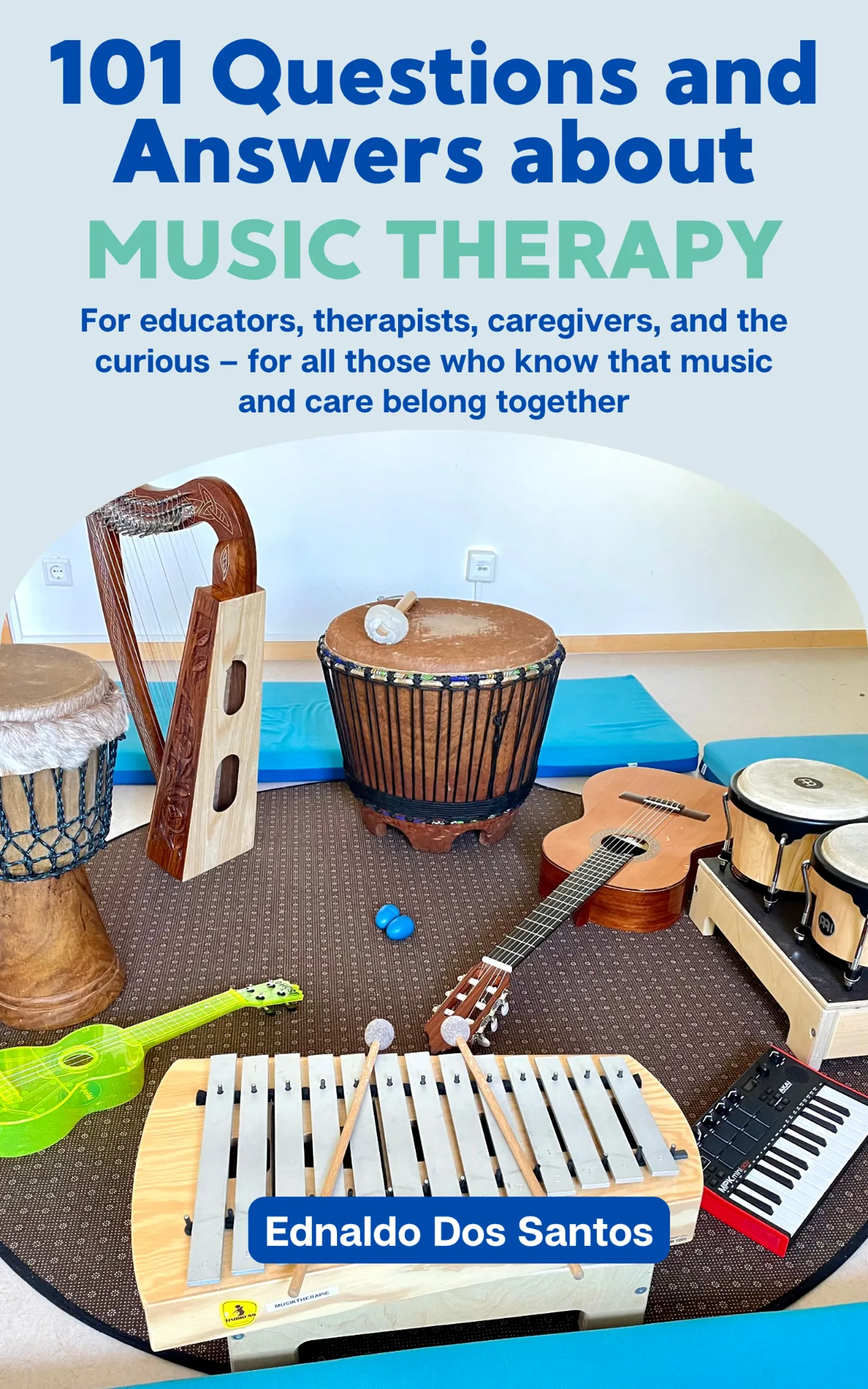
Sources and further reading
- German Music Therapy Society: What is music therapy? (German)
- de Witte, M. et al. (2020): Effects of music interventions on stress-related outcomes: a systematic review and two meta-analyses. Health Psychology Review, 14(2), 294–324.
- de Witte, M. et al. (2022): Music therapy for stress reduction: a systematic review and meta-analysis. Health Psychology Review, 16(1), 134–159.
- Bernardi, L., Porta, C. & Sleight, P. (2006): Cardiovascular, cerebrovascular, and respiratory changes induced by different types of music in musicians and non-musicians. Heart, 92(4), 445–452.
- Thoma, M. V. et al. (2013): The Effect of Music on the Human Stress Response. PLOS ONE, 8(8), e70156.
- World Health Organization (2026): Stress.