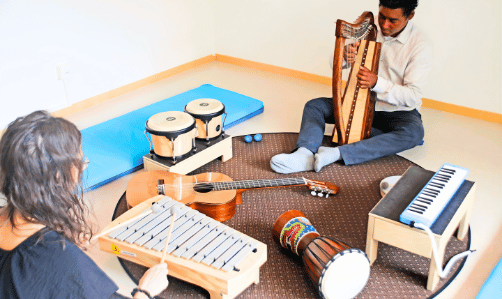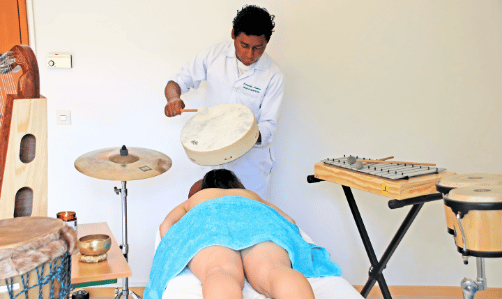

When I participate in scientific congresses in the medical field to present the results of my work in music therapy, many attendees are curious about my professional training and ask whether there are university programs or if music therapy is merely a short-term course.
The Beginning of Music Therapy Education
In 1944, the first music therapy course was introduced at Michigan State University in the United States. In 1946, the first academic Bachelor’s degree program in music therapy was established at the University of Kansas (USA), with pioneering professors such as Dr. Everett Thayer Gaston, Dr. Ira Maximilian Altshuler—a psychiatrist and creator of the ISO principle—and Myrtle Fish Thompson.
Based on this growing demand for trained professionals, many other academic institutions began offering Bachelor’s degree programs in music therapy, both in the United States and internationally.
Today, Bachelor’s degree programs in music therapy typically last three to four years, postgraduate programs last one to two years (depending on the country), Master’s programs last two years, and doctoral programs range from three to four years.
Latin America
Music therapy education in Latin America enjoys high international recognition, particularly for its strong emphasis on clinical and practical training.
Dr. Rolando Benenzon is considered a pioneer of music therapy in Latin America. In 1966, he founded the Bachelor’s degree program in music therapy at the Faculty of Medicine of the University of Salvador in Buenos Aires. He developed the “Non-Verbal Model of Music Therapy” and has since trained professionals across Latin America and Europe. He also founded several music therapy centers that bear his name.
Benenzon significantly contributed to the expansion and recognition of music therapy through his publications, training programs, and the co-founding of music therapy associations in Brazil, Uruguay, Peru, Mexico, Ecuador, Spain, and Venezuela.
In Brazil, public and private universities offer Bachelor’s and postgraduate programs in music therapy.
UBAM (Brazilian Union of Music Therapy Associations)–recognized Bachelor’s programs include:
- UFG (Federal University of Goiás)
- UNESPAR (State University of Paraná)
- UFMG (Federal University of Minas Gerais)
- FMU (Metropolitan United Faculties)
- Faculdades EST
- UFRJ (Federal University of Rio de Janeiro)
- Brazilian Conservatory of Music – CBM-UNICBE
Postgraduate programs:
- Brazilian Conservatory of Music
- CENSUPEG
- Instituto Fênix de Ensino e Pesquisa
- Grupo UNIS
- Faculdade Alpha – Recife/PE
Music Therapy Education in the Americas
In the United States, music therapy education is well established and highly regulated, with clearly defined academic programs, certification processes, and professional standards.
Structured Study and Certification
Professional music therapists in the U.S. typically hold a Bachelor’s or Master’s degree in music therapy from an institution accredited by the American Music Therapy Association (AMTA).
Undergraduate programs include three core areas: musical foundations, clinical foundations, and music therapy principles, along with extensive clinical training totaling more than 1,000 hours of supervised practice.
After graduation, candidates may take the national MT-BC (Music Therapist – Board Certified) examination, which is required for professional practice.
Diversity of Programs and Specializations
Numerous universities in the U.S. offer music therapy programs, such as:
- Berklee College of Music: Bachelor’s degree in Music Therapy with 1,040 clinical hours.
- NYU Steinhardt: Master’s degree focusing on clinical practice, improvisation, and research.
- Nazareth University: Bachelor’s program with broad clinical training.
Additionally, “Equivalency Programs” exist for individuals who already hold degrees in music or related fields, allowing them to complete the required music therapy coursework and clinical training without restarting an entire degree.
Clinical Practice and Professional Fields
U.S. training places strong emphasis on clinical competence. Therapists learn to design treatment plans, implement interventions, document clinical progress, and collaborate with interdisciplinary teams.
Career opportunities include hospitals, clinics, hospices, schools, disability services, psychiatry, geriatrics, and rehabilitation—depending on specialization.
Relevance for International Music Therapists
U.S. standards—structured curricula, intensive clinical training, and national certification— make American music therapy a global reference model. For those seeking a robust, evidence-based education, U.S. programs offer valuable professional benchmarks.
Music Therapy Education in Europe
In many European countries, music therapy is firmly established as an academic discipline, comparable to other therapeutic and psychosocial professions.
Programs integrate music, psychology, medicine, special education, and clinical practice, combining artistic-therapeutic and scientific approaches.
This creates solid academic pathways—from Bachelor’s to Master’s degrees, clinical practice, and research—for professionals in music, healthcare, or education.
- Germany – SRH Heidelberg University: M.A. in Music Therapy (full-time, 4 semesters)
- Germany – Friedensau Adventist University: M.A. in Music Therapy (part-time)
- Austria – University of Music and Performing Arts Vienna: B.A. in Music Therapy
- Austria – IMC University of Applied Sciences Krems: B.Sc. in Music Therapy
- Switzerland – Zurich University of the Arts: Bachelor’s, Master’s, and advanced programs
- Netherlands – ArtEZ University of the Arts: Master’s in Music Therapy
- United Kingdom – Anglia Ruskin University, Queen Margaret University: M.A./M.Sc. in Music Therapy
Clinical Training, Internships, and Supervision
Comprehensive theoretical, ethical, and scientific education—often including research or a Master’s thesis—prepares students thoroughly for professional practice.
Key aspects to consider:
- Differences between state-recognized and private programs
- Musical aptitude and personal maturity requirements
- Regulations for international recognition and equivalency
Music Therapy Education in Asia
In East Asian countries such as Japan, South Korea, and China, formal music therapy education programs exist and are increasingly professionalized and institutionally recognized.
Organizations such as the Japanese Music Therapy Association (JMTA) oversee standards, education, and professional regulation.
- Showa Academia Musicae (Japan)
- Tokushima Bunri University
- Temple University Japan Campus – PhD in Music Therapy
Programs combine musical training, theoretical knowledge, and clinical practice, similar to Western models, while also integrating cultural and social contexts.
Music Therapy Education in Africa
Formal academic music therapy education is rare in Africa. Currently, an accredited Master’s program exists at the University of Pretoria (South Africa): MMus in Music Therapy.
- University of Pretoria – Master’s in Music Therapy
Limited infrastructure, funding, and academic tradition contribute to the scarcity of programs, despite local needs for therapeutic services.
Continuing Education in Music Therapy – Why It Never Ends
After completing formal studies, professional development continues through advanced training models such as the Benenzon Model, GIM, Nordoff-Robbins, and Neurologic Music Therapy.
- Theoretical study
- Practical training
- Supervision
Continuing education enables specialization, clinical confidence, and scientific advancement. My own professional path includes research, academic writing, and international training programs. (In my view, this lifelong learning process is what sustains ethical and effective practice.)
Bibliographic Reference
ABNT
- DOS SANTOS, Ednaldo. Training in Music Therapy. Ednaldo Music Therapy, [publication date]. Available at: https://ednaldomusiktherapie.de/en-us/en-blog/training-in-music-therapy . Accessed on: [access date].
APA (7th edition)
- Dos Santos, E. ([year]). Training in music therapy. Ednaldo Music Therapy. https://ednaldomusiktherapie.de/en-us/en-blog/training-in-music-therapy
Vancouver (numeric style)
- Dos Santos E. Training in music therapy [Internet]. Ednaldo Music Therapy; [year] [cited YYYY Mon DD]. Available from: https://ednaldomusiktherapie.de/en-us/en-blog/training-in-music-therapy
Learn More About Music Therapy
If you are interested in music therapy or would like to know whether this work suits your needs, feel free to contact me.
Email: contact@ednaldomusictherapy.com
WhatsApp: +49 157 54239376