In music therapy, music is not used randomly. Its unique ability to operate beyond linguistic structures and to directly address emotional, physical, and cognitive levels makes it a central therapeutic medium. Music opens access to inner processes that are often difficult to reach through purely verbal methods — especially in situations where words are absent or blocked.
Creativity plays a key role in this process. It is not an end in itself, but a therapeutic factor of change. Through musical experience, an inner space emerges in which new forms of expression become possible. Clients do not experience music passively, but as a process that integrates perception, emotion, memory, and action. At a neural level, networks associated with emotion, motivation, imagination, and problem-solving are activated (in my opinion, this explains why music therapy can be particularly effective in complex psychological and psychosomatic conditions).
In music therapy practice, every sound expression can be understood as a creative act. A single tone, a rhythm, or even intentional silence becomes an element of an inner expressive process. Similar to a blank canvas, musical interventions give rise to new meanings, images, and emotional connections. Music functions both as a mirror of inner states and as a catalyst for change.
Immersion in musical processes often places clients in a state of increased openness and inner flexibility. The boundary between conscious control and spontaneous creation becomes more permeable. It is precisely here that creativity unfolds as a therapeutic space: old patterns can be perceived, varied, or transformed. (I consider this aspect particularly relevant in work with trauma, depression, or psychosocial withdrawal.)
Emotions form the foundation of this process. Music can not only evoke grief, anger, fear, joy, or calm, but also regulate them. It creates a safe framework in which intense emotions can be experienced without becoming overwhelming. This emotional diversity provides fertile ground for creative solutions and new forms of self-perception.
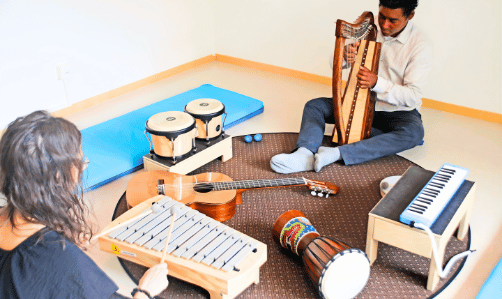
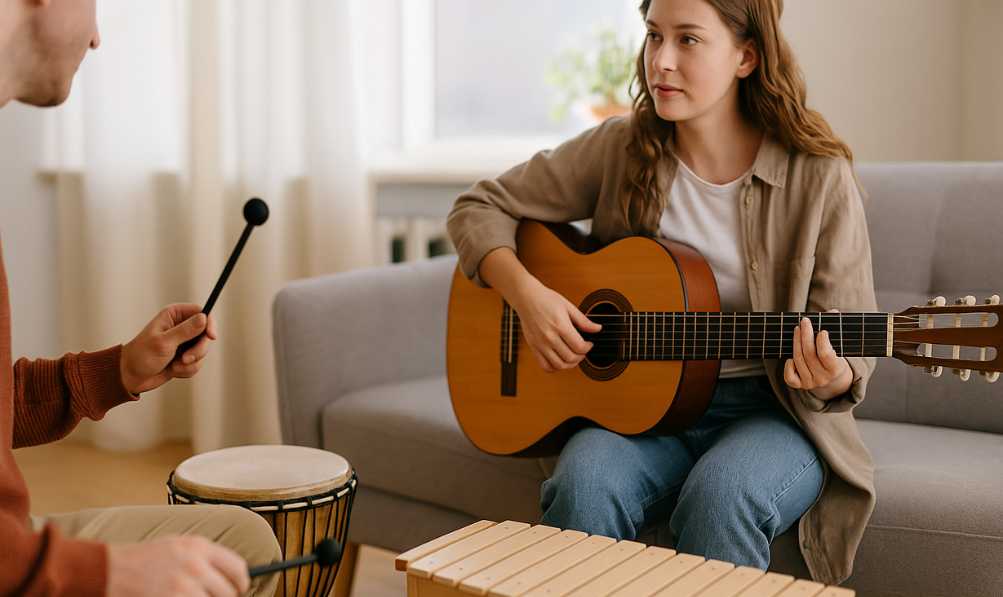
This is especially evident in active music-making. When playing an instrument or engaging in free improvisation, body, perception, and emotion merge into a holistic experience. Improvisation is not about musical performance, but about expressing inner movements in the here and now. It allows clients to let go of control, explore new possibilities for action, and experience self-efficacy. (From a therapeutic perspective, improvisation is one of the most powerful tools for fostering creativity and emotional integration.)
The relationship between music and creativity in music therapy is therefore not decorative, but essential. Music acts as a medium that stimulates inner dialogue, while creativity enables the process of individual meaning-making. Within this symbiosis, development, regulation, and healing can emerge.
Music therapy uses this timeless connection deliberately and responsibly: not to produce “beautiful sounds,” but to support individuals in discovering their inner resources, developing new perspectives, and creatively connecting with themselves and the world. (For me, this is where the deepest therapeutic power of music resides.)
Bibliographic Reference
ABNT
- DOS SANTOS, Ednaldo. Music and Creativity in the Context of Music Therapy. Ednaldo Musiktherapie, [publication date]. Available at: https://ednaldomusiktherapie.de/de-de/de-blog/musik-und-kreativitaet-im-kontext-der-musiktherapie . Accessed on: Dec 04, 2025.
APA (7th edition)
- Dos Santos, E. ([year]). Music and Creativity in the Context of Music Therapy. Ednaldo Musiktherapie. https://ednaldomusiktherapie.de/de-de/de-blog/musik-und-kreativitaet-im-kontext-der-musiktherapie
Vancouver (numeric style)
- Dos Santos E. Music and Creativity in the Context of Music Therapy [Internet]. Ednaldo Musiktherapie; [year] [cited 2025 Dec 04]. Available from: https://ednaldomusiktherapie.de/de-de/de-blog/musik-und-kreativitaet-im-kontext-der-musiktherapie
Learn More About Music Therapy
If you are interested in music therapy or would like to know whether this work fits your needs, feel free to contact me.
Email: contact@ednaldomusictherapy.com
WhatsApp: +49 157 54239376