
Music possesses a unique ability: it transcends language barriers and acts directly on the deepest layers of human experience. It is precisely there that its power unfolds—as a trigger for emotions, thoughts, and inner images that set creative processes in motion. The relationship between listening to music and creativity resembles a finely tuned interplay that unfolds simultaneously on sensory, emotional, and cognitive levels.
Creativity can be imagined as a blank canvas on which each musical note becomes a brushstroke. As a melody unfolds, colors, contrasts, and movement emerge. Every rhythm releases energy; every sound reshapes the inner landscape. Music is not merely an acoustic stimulus—it becomes a catalyst that places the mind in a state of heightened openness and inspiration.
This “invisible fabric” woven between sounds activates imaginative processes, fosters associations, and invites the mind to adopt new perspectives. Music is not simply a structure of tones and rhythms, but an invitation to move beyond familiar boundaries and explore the realm of imagination.
When we immerse ourselves deeply in a musical composition, states emerge in which the boundary between reality and fantasy gradually blurs. Neuroscientific research shows that music activates brain networks associated with emotion, memory, and creative problem-solving. As a result, mental “portals” are opened that allow ideas to be recombined, unusual connections to be formed, and innovative solutions to be discovered. (In my view, this state is particularly valuable during periods of high mental strain.)
Creativity thrives on emotion—especially tension, contrast, and intense inner states. Music offers an extraordinarily rich spectrum in this regard: the melancholy of a quiet ballad, the euphoria of a pulsating rhythm, or the inner order of a classical composition. Each of these emotional qualities creates fertile ground for creative expression.
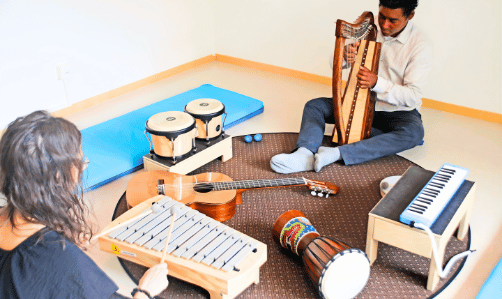
This process becomes even more immediate when people actively make music themselves. Playing an instrument or consciously shaping sound opens direct access to inner processes. Improvisation, in particular, is considered one of the purest forms of spontaneous creativity, where perception, emotion, and motor action merge into a unique creative moment. (I am convinced that this pathway is often underestimated in therapeutic and educational contexts.)
Ultimately, the relationship between music and creativity is a living symbiosis. Music takes on the role of the muse—it inspires, structures, and opens space. Creativity, in turn, gives form and expression to inner experience. Together, they invite us to transcend habitual patterns of thought and explore new possibilities.
Within this timeless connection, music becomes an inexhaustible source—not only for artistic expression, but also for personal growth, innovation, and intellectual freedom. (For me, this is precisely the core of its therapeutic and creative power.)
Bibliographic Reference
ABNT
- DOS SANTOS, Ednaldo. Music and Creativity. Ednaldo Music Therapy, December 5, 2025. Available at: https://ednaldomusiktherapie.de/en-us/en-blog/music-and-creativity . Accessed on: December 4, 2025.
APA (7th edition)
- Dos Santos, E. (2025, December 5). Music and creativity. Ednaldo Music Therapy. https://ednaldomusiktherapie.de/en-us/en-blog/music-and-creativity
Vancouver (numeric style)
- Dos Santos E. Music and creativity [Internet]. Ednaldo Music Therapy; 2025 Dec 05 [cited 2025 Dec 04]. Available from: https://ednaldomusiktherapie.de/en-us/en-blog/music-and-creativity
Learn More About Music Therapy
If you are interested in music therapy or would like to know whether this work suits your needs, feel free to contact me.
Email: contact@ednaldomusictherapy.com
WhatsApp: +49 157 54239376