

Did you know that music can be a powerful therapeutic method? However, it is important to emphasize that using music in therapy requires the presence of a qualified professional: the music therapist. Today, I would like to talk about the fundamental role of this professional in music therapy practice.
Music therapy is still relatively unknown, even though it has existed for thousands of years. A music therapist is a professional with a background in music and a university degree or postgraduate training in music therapy. Since the first music therapy course was established at the University of Kansas in 1946, the field has developed and expanded across many countries.
During training, music therapists develop knowledge across multiple areas such as health (anatomy, physiology, neurology, psychopathology), music (history, musical language, instrumental practice), and profession-specific topics (history of music therapy, different models and methods).
Therapeutic Setting
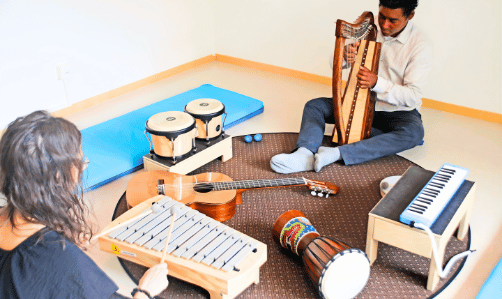
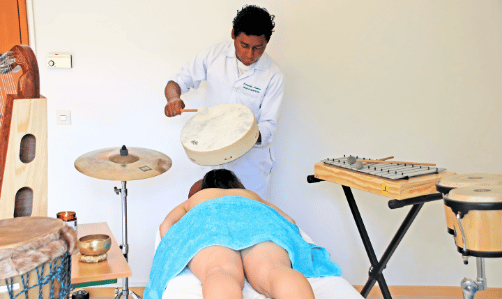
After graduation, the music therapist uses sound resources such as live or recorded music, musical instruments, and even natural sounds to help individuals or groups achieve improvements in different areas of life, including psychological, physical, physiological, neurological, and social aspects. This practice can lead to significant improvements in participants’ quality of life.
There are many music therapy methods and models, including improvisation, re-creation, composition, and receptive therapy. Each of these models can be used depending on the goals defined for the session and can enable active or passive musical experiences.
Continuing Education
After completing a university degree, a music therapist may specialize in one or more music therapy models. Some of the most internationally recognized models include Clifford Madsen’s behavioral method, Nordoff-Robbins improvisation, Helen Bonny’s Guided Imagery and Music (GIM), Benenzon’s nonverbal method, Mary Priestley’s analytical method, Dr. Víctor Muñoz Pólit’s humanistic approach, and Dr. Diego Schapira’s plurimodal method.
Applications of Music Therapy
It is important to emphasize that music therapists do not only work with people with disabilities. They also support personal development, help prevent conditions such as depression, reduce stress and anxiety, and assist in addressing emotional issues related to trauma and other individual needs.
Would you like to learn more about the work of music therapists and their contribution to improving quality of life? Then follow the channel and stay tuned, because I will be publishing more content on this topic soon. You can also follow me on Instagram, where I share daily content, and visit my website, where you will find articles about music therapy, music and health, as well as the courses I offer.
Bibliographic Reference
ABNT
- DOS SANTOS, Ednaldo. What Is a Music Therapist? Ednaldo Music Therapy, Aug 16, 2024. Available at: https://ednaldomusiktherapie.de/en-us/en-blog/what-is-a-music-therapist . Accessed on: Dec 03, 2025.
APA (7th edition)
- Dos Santos, E. (2024, August 16). What is a music therapist?. Ednaldo Music Therapy. https://ednaldomusiktherapie.de/en-us/en-blog/what-is-a-music-therapist
Vancouver (numeric style)
- Dos Santos E. What is a music therapist? [Internet]. Ednaldo Music Therapy; 2025 Dec 03 [cited 2025 Dec 03]. Available from: https://ednaldomusiktherapie.de/en-us/en-blog/what-is-a-music-therapist
Learn More About Music Therapy
If you are interested in music therapy or would like to know whether this work fits your needs, feel free to contact me.
Email: contact@ednaldomusictherapy.com
WhatsApp: +49 157 54239376




Social Media
Connect with me on different channels and discover even more content about music therapy.
Instagram
Daily practical tips on how music can support your well-being, focus, and relaxation. Follow @ednaldomusictherapy.
Follow meLinkedin
Weekly videos with music therapy tips for your well-being, emotions, and self-expression. Subscribe now.
Follow meBlog
Explore articles, studies, and tips on music therapy, health, and well-being — and learn how to apply them in everyday life.
Learn more